For home care agencies, this year has more to close out than usual. 2026 is the first year employers must report qualified overtime on Form W-2, and caregivers are among the workers most affected. On top of that, wage bases and state minimum wages change on January 1, and the federal rules on companionship and live-in exemptions are still unsettled.
Here is what to prepare, in order, and why the agencies with payroll built into their care software will have the easiest January.
1. Know your year-end deadlines
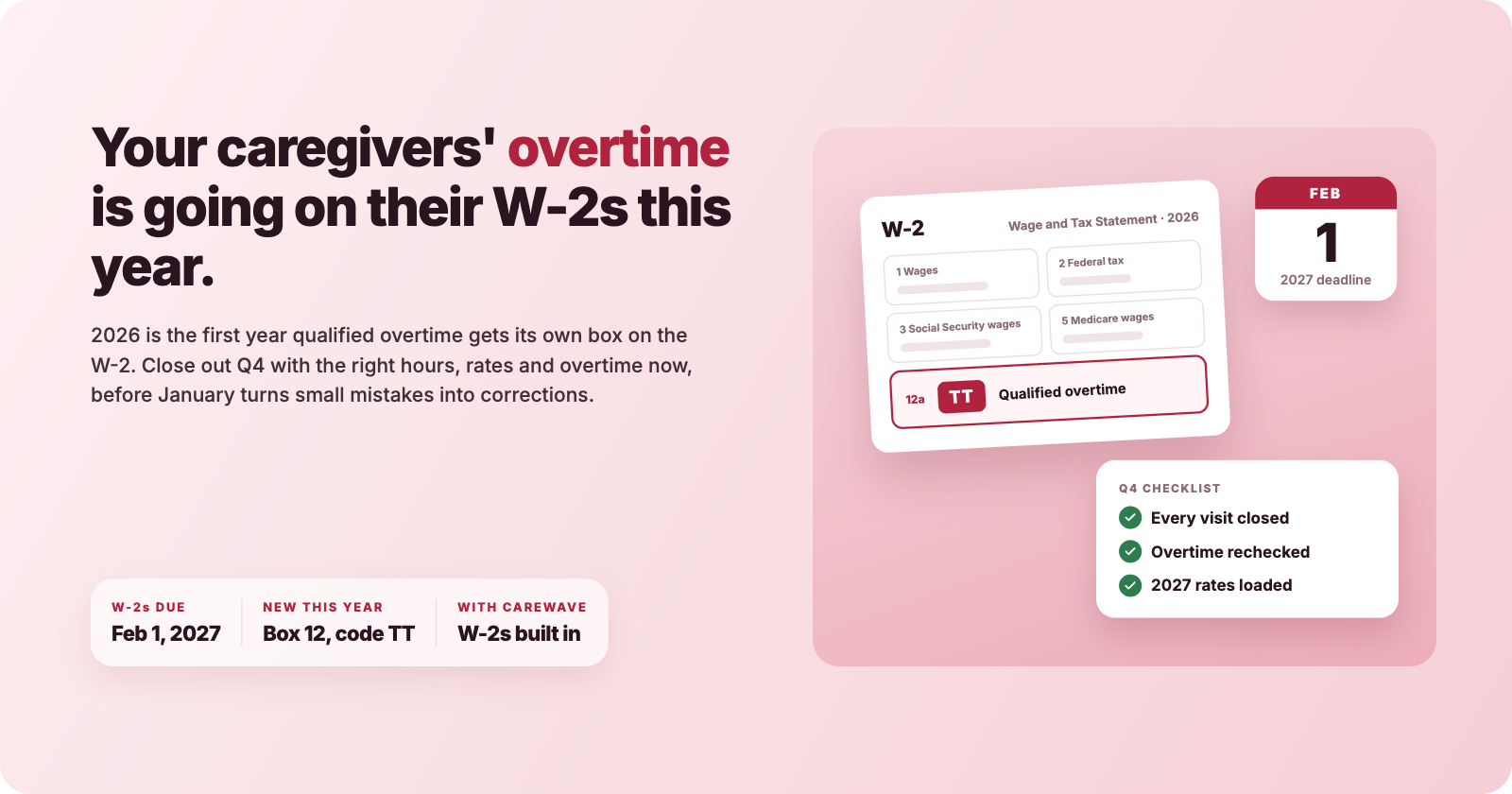
January 31, 2027 falls on a Sunday, so the usual January 31 federal deadlines move to Monday, February 1, 2027. That gives you one extra day, not one extra week.
| What | Who it's for | Due |
|---|---|---|
| Form W-2 to each caregiver and employee | Every W-2 employee paid in 2026 | February 1, 2027 |
| Form W-2 Copy A and W-3 to the Social Security Administration | Your agency's filing | February 1, 2027 |
| Form 941 for Q4 2026 | Federal withholding, Social Security and Medicare for October to December | February 1, 2027 |
| Form 940 | Annual federal unemployment (FUTA) | February 1, 2027 |
| Form 1099-NEC | Independent contractors paid $2,000 or more in 2026 (up from $600) | February 1, 2027 |
| State quarterly wage and unemployment reports | Varies by state | Check your state; most are due at the end of January |
Extensions are limited. An extension to file W-2s with the SSA is not automatic and requires Form 8809. An extension to give W-2s to employees requires a separate request and is generally capped at 15 days. Penalties for late or incorrect W-2s also go up for returns due after December 31, 2026.
One more change worth knowing: for wages paid after 2025, the threshold for issuing a W-2 when no tax was withheld rises from $600 to $2,000. Most caregivers will still get one, since taxes are withheld from nearly every paycheck.
2. Get ready for what's new on 2026 W-2s
Qualified overtime now has its own box. Under the 2025 tax law, workers can deduct up to $12,500 of qualified overtime pay ($25,000 if married filing jointly) on their federal income tax return, for tax years 2025 through 2028. Starting with 2026 W-2s, employers must report that amount in Box 12 with code TT.
This matters a great deal in home care, where overtime is common. But the definition is narrow:
- Only the "half" in time-and-a-half counts. If a caregiver earns $20 an hour and works overtime at $30, only the extra $10 per overtime hour is qualified overtime.
- Only overtime required by the federal Fair Labor Standards Act counts. Overtime paid only because of a state rule, such as daily overtime, or paid voluntarily to a worker who is exempt under federal law, generally does not.
- The figure must be calculated from the regular rate, which for caregivers with several pay rates is usually a blended rate. If your overtime math was wrong during the year, the Box 12 TT amount will be wrong too.
That makes the exemption question more than a legal footnote. In July 2025 the Department of Labor proposed restoring the companionship and live-in exemptions for home care agencies and stopped enforcing the 2013 rule that removed them. That proposal is still not final, and in April 2026 the Sixth Circuit upheld the 2013 rule. Whether your agency treats caregivers as overtime-eligible under federal law affects both what you pay and what you report. Confirm your position with an employment attorney before you file.
Other numbers changing on January 1, 2027:
- Social Security wage base: rises from $184,500 to $192,300. Few caregivers reach it, but office staff and owners on payroll may.
- State minimum wages: many states adjust on January 1. In Washington, for example, the minimum wage rises from $17.13 to $17.73 an hour. Update caregiver pay rates before the first pay period of 2027, not after.
- Medicaid rates and pass-through rules: if your state raised home care rates or has a wage pass-through requirement, confirm the new caregiver pay rates are loaded and dated correctly.
3. The Q4 checklist for home care agencies
Work through these in order. Each step depends on the one before it.
- Lock down caregiver records. Confirm every caregiver's legal name, Social Security number and mailing address match their W-4 and I-9. A wrong SSN or old address is the most common reason a W-2 bounces or needs a correction. Caregivers move often, so ask everyone to confirm before December 15.
- Close every open visit. Find visits with a missing clock-out, an unapproved edit or an EVV exception, and resolve them now. Every hour that is still open in late December is an hour that may be paid in the wrong year or not at all.
- Reconcile hours across the year. Compare the total hours on payroll to the total verified visit hours and travel time for each caregiver. Gaps usually point to manual timesheets, phone-in hours or edits that never made it into payroll.
- Recheck overtime and the regular rate. Pull every caregiver who worked over 40 hours in any week this year. Confirm overtime was calculated on the blended regular rate across all their pay rates, and that hours from different clients were added together. Fix underpayments before year end; they are far cheaper to correct now than after a complaint.
- Separate qualified overtime. From those overtime records, calculate the overtime premium required under federal law for each caregiver. That is your Box 12 code TT figure.
- Review mileage and reimbursements. Make sure mileage paid at or below the IRS rate is treated as a non-taxable reimbursement, and that any amount above it is included in wages.
- Catch the year-end extras. Holiday bonuses, retention bonuses, gift cards and other cash-equivalent gifts are taxable wages. Run them through payroll before December 31 so they land on the right W-2.
- Balance your quarterly returns. The wages and taxes on your four 941s for 2026 should add up to the totals on your W-2s and W-3. Find and fix differences before you file, not after the IRS writes to you.
- Update rates for January 1. Load new minimum wage, Medicaid and contract rates, plus any 2027 tax table and wage base changes, so the first payroll of 2027 is right from day one.
- Tell caregivers when and where their W-2s will arrive. Paper or electronic, by February 1, and who to call with questions. This one email saves your office dozens of calls in January.
4. What caregivers should check before year end
Share this list with your caregivers. A few minutes from them in December prevents most W-2 corrections in February.
- Your address. If you moved this year, update it now so your W-2 reaches you.
- Your name and Social Security number. They should match your Social Security card exactly, including any name change.
- Your last pay stub of the year. Compare year-to-date hours and pay against your own records. If a visit or overtime week looks missing, raise it before December 31.
- Your overtime. If you worked more than 40 hours in a week this year, you may be able to deduct part of your overtime pay on your 2026 tax return. Look for the code TT amount in Box 12 of your W-2.
- Your W-4. If your household or second job changed this year, update your withholding for 2027.
Caregivers should talk with a tax professional about their own deductions. This is general information, not tax advice.
5. Why year end is easier when payroll is built in
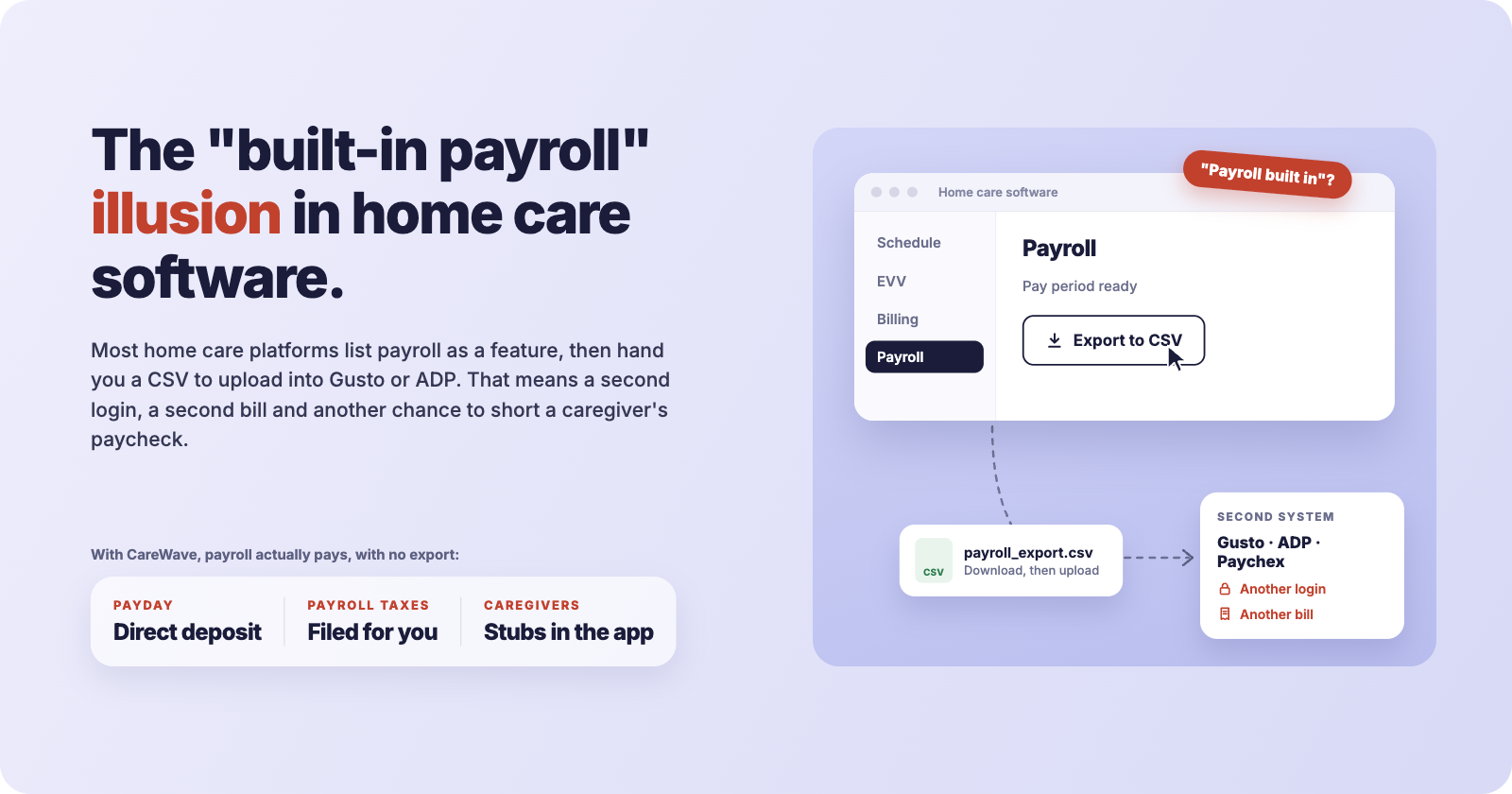
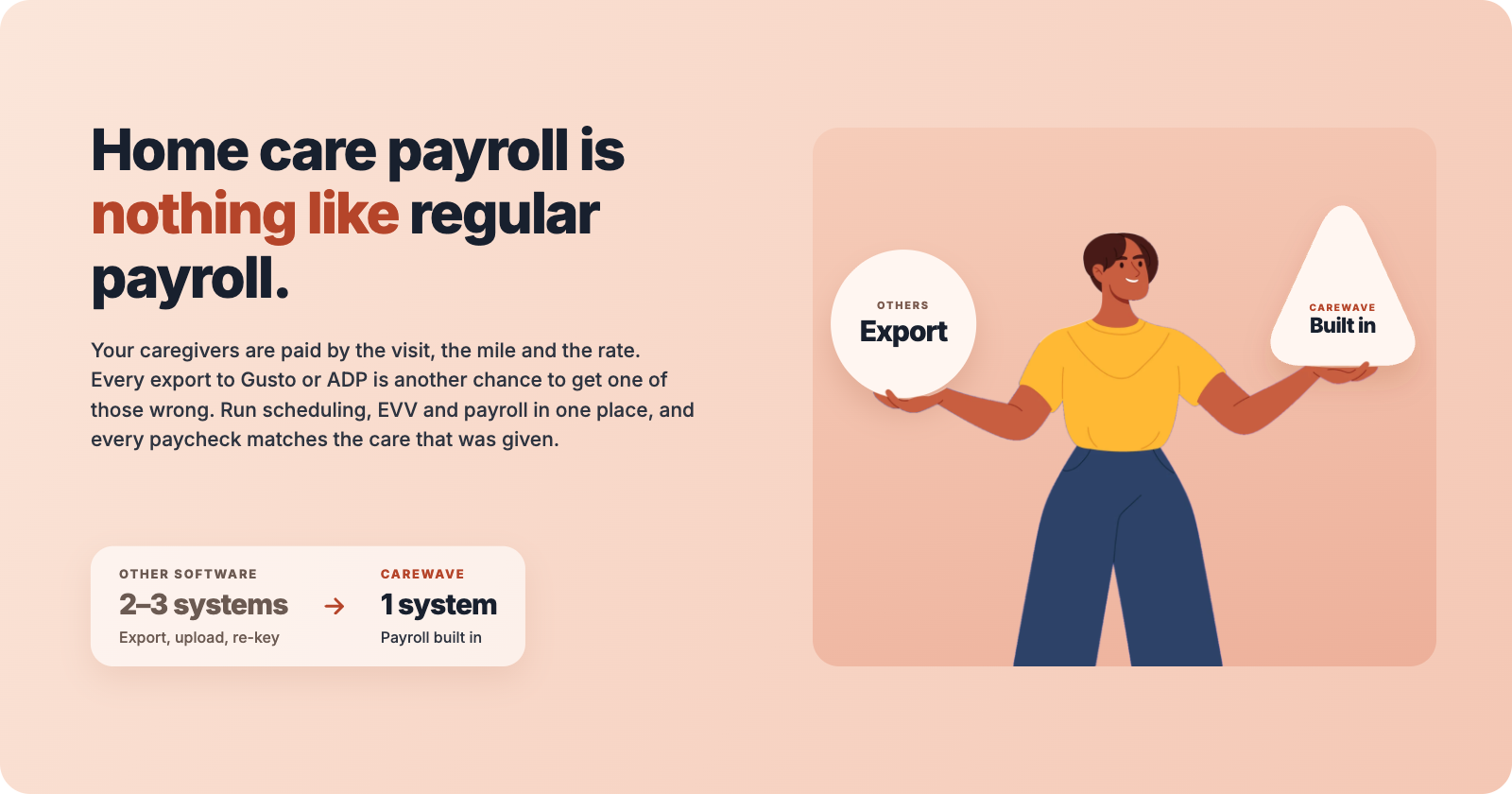
Look back at the checklist. Almost every step is a reconciliation: hours against visits, overtime against rates, payroll against EVV, quarterly returns against W-2s. When your care software and your payroll provider are two separate systems, each of those steps means exporting, matching and fixing rows by hand, in the busiest weeks of the year.
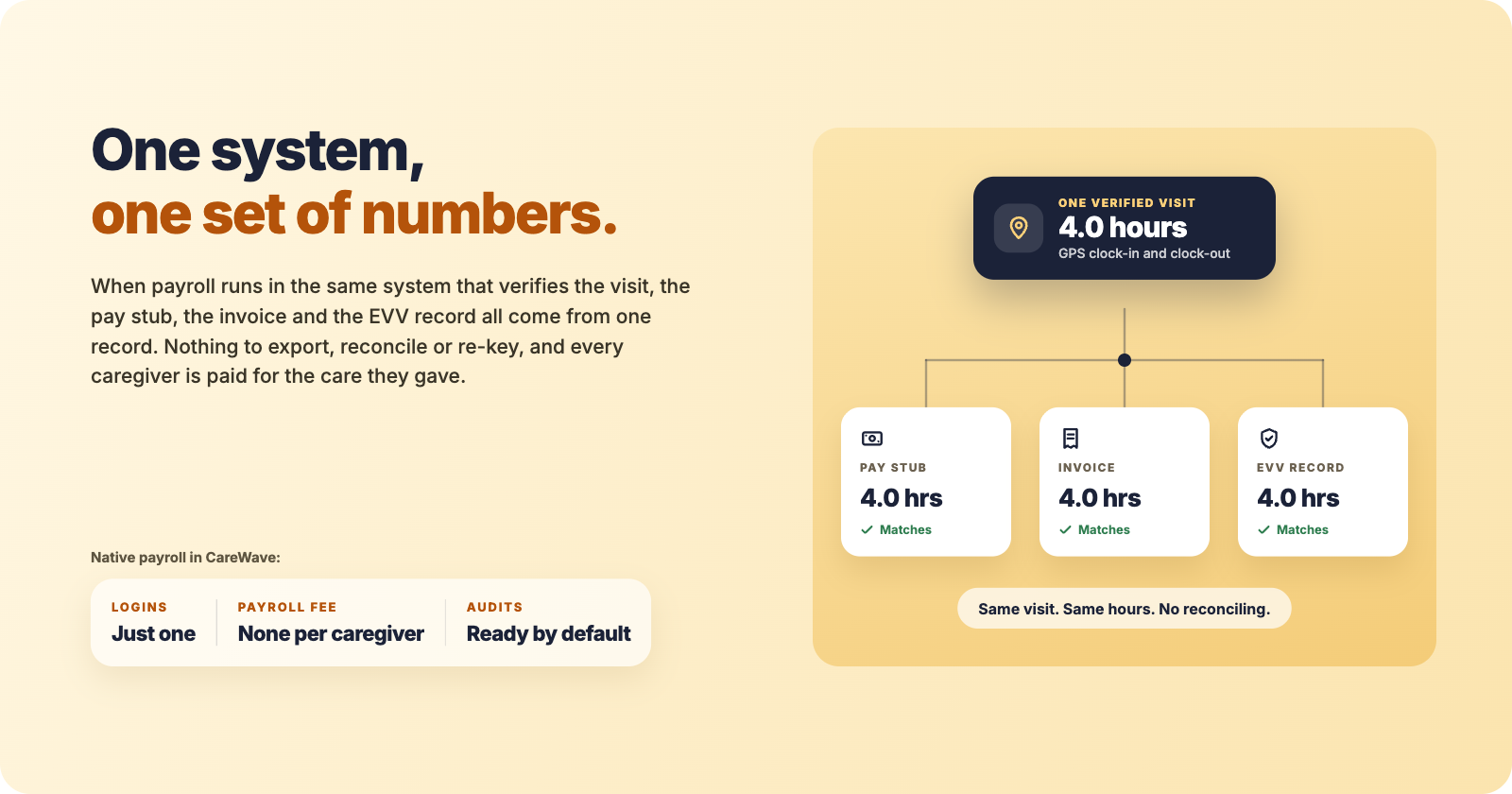
When payroll runs inside your care platform, most of that work disappears, because there is only one set of numbers to begin with.
- Hours are already verified. In CareWave, every paid hour comes from a GPS-verified clock-in and clock-out. There is no year-end hunt for timesheets that never matched a visit.
- Overtime is calculated where the rates live. Each caregiver's rates, overtime and mileage are applied to the same verified hours. The overtime on the pay stub, the hours on the invoice and the EVV record all come from one visit.
- W-2s come from the same system. CareWave files federal, state and local payroll taxes and produces W-2s and 1099s at year end, so there is no file to send to a second provider in January.
- Caregivers can check their own records. Pay stubs live in the same CareWave app caregivers use to clock in, so they can spot a missing visit in December instead of on their W-2.
- You see overtime coming. The Monday Wave Digest flags overtime risk early, so you can rebalance the schedule before it shows up on payroll.
- No per-caregiver payroll fee. Payroll is included in every CareWave plan, with flat monthly pricing from $499. Seasonal and part-time caregivers don't push your payroll bill up.
Start 2027 with one system
Year end shows you exactly how many systems your agency runs on, because it's the moment they all have to agree. If this January means another round of exports, mismatched hours and W-2 corrections, it's a good time to change how payroll works before the next year begins.
See a real year-end-ready pay run on your own caseload. Start a free trial or book a demo.
This article is general information, not legal or tax advice. Confirm deadlines and rules for your state with a payroll or tax professional.